Hey there! I’m working for an overhead line tower supplier, and I’ve seen firsthand the whole process of installing these massive structures. It’s a pretty fascinating journey from the factory to the final standing in the wild, and I’m stoked to share it with you. Overhead Line Tower

Planning and Preparation
Before we even start thinking about getting the tower on – site, there’s a ton of planning that goes into it. First off, we gotta do some serious research on the area where the tower is gonna be installed. This includes things like the topography of the land. Is it flat, hilly, or maybe even in a marshy area? We need to know because it affects how the tower will be built and supported.
We also look at the soil conditions. Different types of soil have different load – bearing capacities. For example, sandy soil might require a different foundation design compared to clay soil. We use special equipment to test the soil, like cone penetrometers, which are basically long rods that we push into the ground to measure how hard it is to penetrate at different depths.
Another crucial part of the planning is the electrical requirements. We need to figure out how much power the line is going to carry, what kind of voltage it’ll operate at, and how far the transmission needs to go. This determines the size and design of the tower. A tower for a high – voltage long – distance transmission line is gonna be way bigger and more robust than one for a local distribution line.
Once we’ve got all this info, our engineers get to work on designing the tower. They use computer – aided design (CAD) software to create detailed 3D models of the tower. These models help us visualize how the tower will look and function, and we can also use them to simulate different conditions, like high winds or heavy ice loads, to make sure the tower can handle it.
Manufacturing the Tower
After the design is finalized, it’s time to start manufacturing. We’ve got a state – of the – art factory where all the magic happens. The first step is to cut the steel components. We use large cutting machines, like plasma cutters or laser cutters, to get precise and clean cuts. These pieces are then shaped and bent according to the design specifications.
Next up is the welding process. This is a super important step because a good weld is what holds the whole tower together. Our welders are highly skilled, and they use advanced welding techniques to ensure strong and durable joints. Once the welding is done, the tower components go through a quality control check. We use non – destructive testing methods, like ultrasonic testing and magnetic particle testing, to look for any hidden defects in the welds or the steel.
After passing the quality control, the tower components are painted. The paint is not just for looks; it’s a protective layer that helps prevent rust and corrosion. We use special paints that are designed to withstand harsh environmental conditions, like UV rays and moisture.
Transporting the Tower
Once the tower is all manufactured and ready to go, we need to get it to the installation site. This can be a bit of a challenge, especially if the site is in a remote area. We usually break the tower down into smaller components for easier transportation. These components are loaded onto trucks or trailers and shipped to the site.
We have to be really careful during transportation to make sure the components don’t get damaged. We use special padding and restraints to secure the parts in place. And we also have to follow all the transportation regulations, like weight limits and route restrictions.
On – site Installation
When the components arrive at the installation site, the real work begins. The first step is to prepare the foundation. Depending on the soil conditions and the size of the tower, the foundation can be of different types. For example, a shallow foundation might be used for smaller towers on stable soil, while a deep foundation, like a pile foundation, could be necessary for larger towers on weaker soil.
To build the foundation, we first dig a hole or drill a series of holes in the ground. Then, we place steel reinforcement bars in the holes and pour concrete. The concrete needs to be properly mixed and cured to ensure it has the right strength. This can take a few days, so we have to be patient.
Once the foundation is ready, it’s time to start assembling the tower. We use cranes to lift the components into place. The workers on the ground and on the crane work together to make sure each part is aligned correctly. It’s a bit like a giant jigsaw puzzle, and it takes a lot of skill and coordination.
As the tower goes up, we also start installing the electrical components, like insulators and conductors. The insulators are used to keep the electrical current from flowing into the tower, and the conductors are the wires that carry the electricity. These components need to be installed carefully to ensure the safety and efficiency of the power transmission.
After the tower is fully assembled and the electrical components are installed, we do a final inspection. We check for any loose bolts, misaligned parts, or electrical problems. We also test the tower to make sure it can withstand the expected loads and environmental conditions.
Why Choose Our Overhead Line Towers
So, why should you choose our overhead line towers? Well, first of all, we have a team of experienced engineers and workers who know their stuff. They’ve been in the industry for years, and they’re constantly learning and improving their skills.
Our manufacturing process is top – notch. We use the latest technology and high – quality materials to ensure that our towers are strong, durable, and reliable. We also have a strict quality control system in place to make sure every tower that leaves our factory meets the highest standards.
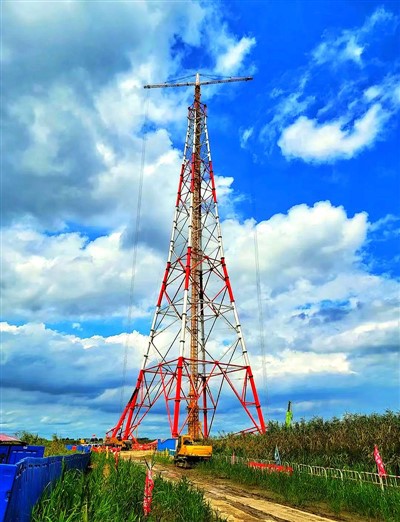
We also offer excellent customer service. We work closely with our clients from the planning stage all the way to the installation. We’re always available to answer any questions you might have and to provide support whenever you need it.
Lightning Protection Steel Tower If you’re in the market for overhead line towers, whether it’s for a small – scale project or a large – scale power grid expansion, we’d love to hear from you. We can provide you with detailed information about our products and services, and we can work with you to come up with the best solution for your needs. Just reach out to us, and let’s start a conversation about how we can help you with your overhead line tower requirements.
References
- "Electrical Transmission and Distribution Reference Book"
- "Structural Engineering Handbook for Overhead Line Towers"
Hebei Yifeng Steel Structure Co., Ltd.
As one of the most professional overhead line tower manufacturers and suppliers in China, we offer a wide range of products with superior quality. Please feel free to buy cost-efficient overhead line tower for sale here from our factory. Contact us for more details.
Address: Guangchuan Town Industrial Zone, Jing County, Hengshui City, Hebei Province
E-mail: hbyfgjg@163.com
WebSite: https://www.yf-powertowers.com/
